What Are the Odds of a Double or a Turkey in Bowling? Data From 500,000 Games
We analyzed the frames of about 500,000 games logged in the Bosc bowling score app to find how often bowlers throw doubles and turkeys, and whether strikes really come in streaks. A turkey happens in about 1 in 3 games.
23 Oct, 2026"After a strike, it feels like the next one comes easier."
We went through the frames of about 500,000 games logged in Bosc, a bowling score tracking app, to find how often doubles and turkeys happen — and whether strikes really come in streaks. Here's what we found, with five charts and tables.
Key Findings
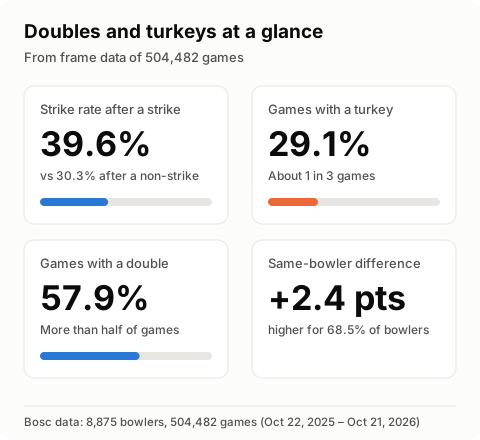
- 57.9% of games include a double, and 29.1% include a turkey (about 1 in 3 games)
- The strike rate right after a strike is 39.6%, about 9 points higher than after a non-strike (30.3%)
- Most of that gap comes from better bowlers striking more often. Comparing each bowler with themselves, the gap is +2.4 points, and it's positive for about 7 in 10 bowlers
- Bowlers averaging 180+ throw a turkey in more than half of their games
- The strike rate is lowest in the 1st frame (32.5%) and doesn't drop in the 10th frame
About the Data
| Item | Details |
|---|---|
| Games | 504,482 games where 8,875 Bosc users recorded all 10 frames |
| Period | Oct 22, 2025 – Oct 21, 2026 (date bowled) |
| Consecutive strikes | Includes bonus balls in the 10th frame (double = 2 in a row, turkey = 3 in a row) |
| Strike rate after a strike | First-ball strike rate in frames 2–10, split by the result of the previous frame |
- We recalculated every game's score from its frames and only used games that matched the recorded score.
- Only aggregated figures that cannot identify any individual are published. Groups with fewer than 30 bowlers are excluded.
- These are people who keep tracking their scores, so strikes are more common than for bowlers overall.
How Often Doubles and Turkeys Happen
| Consecutive strikes | Share of games | Roughly |
|---|---|---|
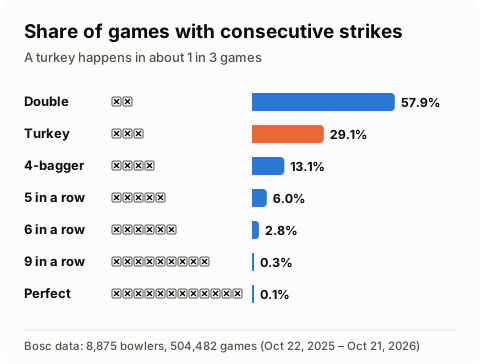
| Double (2+ in a row) | 57.9% | More than 1 in 2 games |
| Turkey (3+ in a row) | 29.1% | About 1 in 3 games |
| 4-bagger (4+) | 13.1% | About 1 in 8 games |
| 5+ in a row | 6.0% | About 1 in 17 games |
| 6+ in a row | 2.8% | About 1 in 36 games |
| 9+ in a row | 0.3% | About 1 in 300 games |
| 12 in a row (perfect game) | 0.1% | About 1 in 2,000 games |
A turkey happens in about 1 in 3 games. Each additional strike in a row roughly halves how often it happens.
Do Strikes Come in Streaks?
| Previous frame | Strike rate in the next frame |
|---|---|
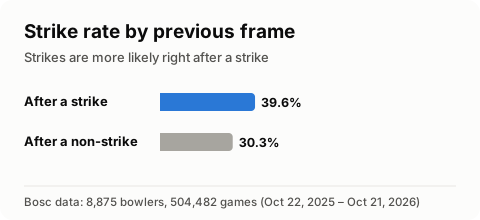
| Strike | 39.6% |
| Non-strike | 30.3% |
| Same-bowler difference (median) | +2.4 points |
| Bowlers with a higher rate after a strike | 68.5% (of 5,201) |
Overall, strikes look about 9 points more likely right after a strike. But that includes the fact that better bowlers strike more often, so their previous frame is more often a strike too.
So we compared each bowler with themselves, using the 5,201 bowlers with at least 30 frames after a strike and 30 after a non-strike. The gap shrinks to +2.4 points, but about 7 in 10 bowlers still strike more often right after a strike.
Even for the same bowler, being lined up with the lane and staying in rhythm seems to make strikes come in streaks — to a modest degree.
Doubles and Turkeys by Bowling Average
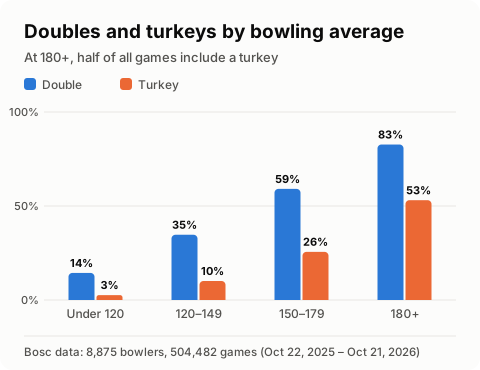
| Average | Games with a double | Games with a turkey | Bowlers |
|---|---|---|---|
| Under 120 | 14.4% | 2.6% | 874 |
| 120–149 | 34.7% | 10.1% | 1,820 |
| 150–179 | 59.1% | 25.6% | 2,234 |
| 180+ | 82.7% | 53.1% | 1,482 |
Bowlers averaging 180+ throw a turkey in more than half of their games, compared with about 1 in 40 games for bowlers under 120 — a 20x difference.
Strike Rate by Frame
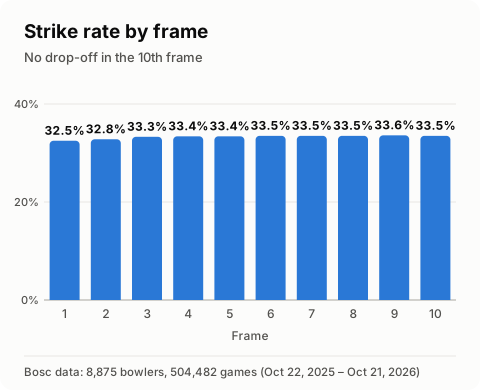
| Frame | Strike rate |
|---|---|
| 1st | 32.5% |
| 2nd | 32.8% |
| 3rd–9th | 33.3–33.6% |
| 10th | 33.5% |
The strike rate is lowest in the 1st frame and nearly flat after that. There's no sign of a pressure drop-off in the 10th frame.
The first game of the day tends to score lower too — see Which Game Do Bowlers Score Highest In?
How to Throw More Turkeys
- After a strike, don't change your line or rhythm. Even for the same bowler, strikes are more likely right after a strike.
- Take extra care in the 1st frame. It has the lowest strike rate of any frame.
- Raise your average. How often you throw turkeys changes 20x across average levels.
To see how many strikes a 200 game takes, read How Many Strikes Do You Need to Bowl a 200?
Track Your Doubles and Turkeys
With the Bosc score tracking app, log your scores frame by frame and Bosc automatically tracks your strike rate and your longest strike streak.
FAQ
What are the odds of bowling a turkey?
In Bosc data, 29.1% of games include a turkey (three strikes in a row) — about 1 in 3 games. For bowlers averaging 180+, it's 53.1%.
What are the odds of bowling a double?
57.9% of games include a double (two strikes in a row).
Are you more likely to strike after a strike?
Overall, the strike rate is 39.6% after a strike and 30.3% after a non-strike. Comparing each bowler with themselves, the gap shrinks to +2.4 points, but about 7 in 10 bowlers still strike more often right after a strike.
Data in this article comes from scores logged by users of the Bosc bowling score app, aggregated so that no individual can be identified (compiled Oct 22, 2026). If you cite these figures, please link to this article as the source.